
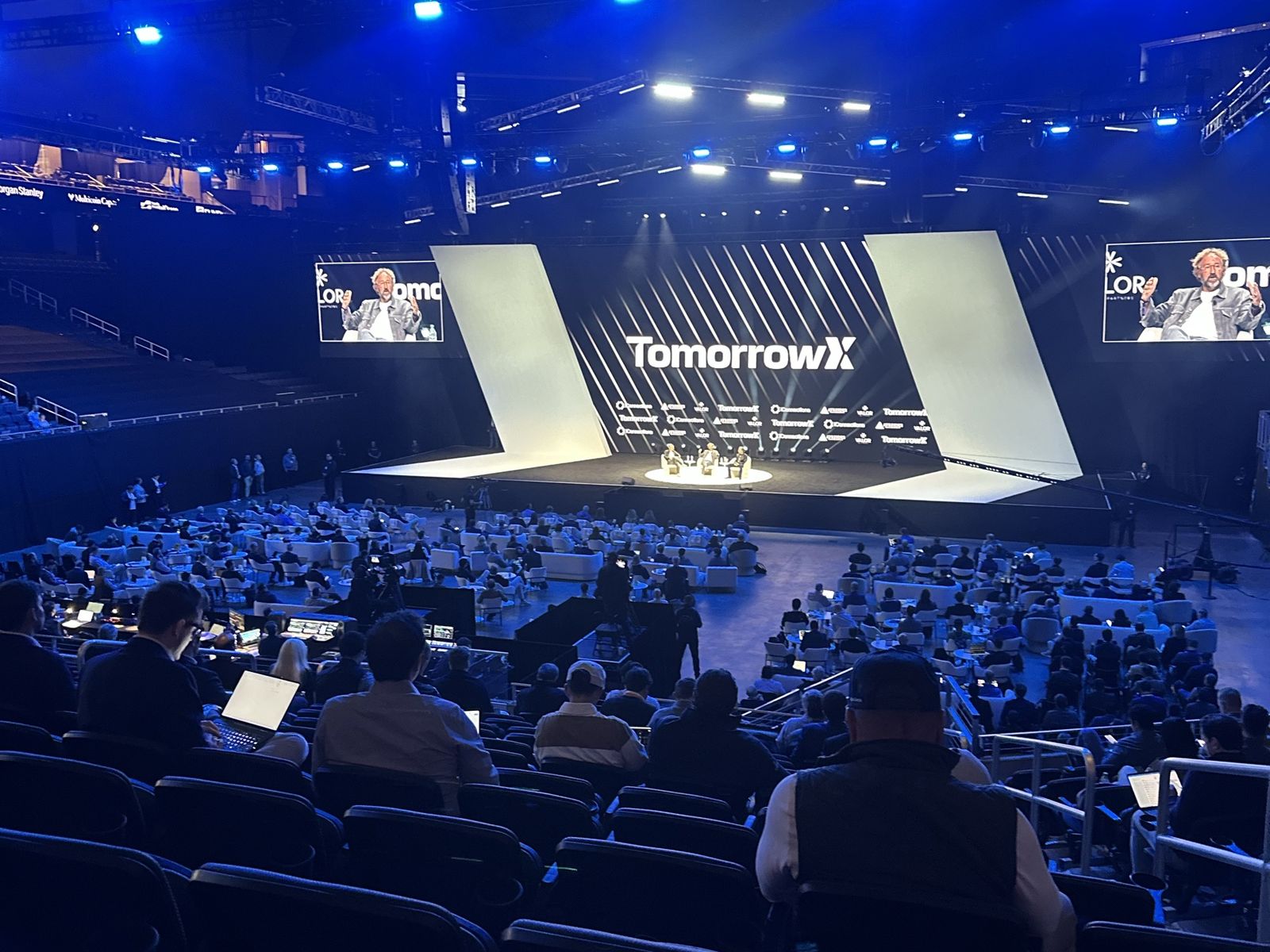
TomorrowX was two days of tech CEOs and investors, and I was there as a first-year MBA in marketing. The arguments I found most interesting were about who carries the risk.
In November I went to TomorrowX Summit at the Moody Center on the UT Austin campus, on a student pass. It's invite-only, and its own website pitches it as "two days with the CEOs in your portfolio." The theme was how AI can revive the American dream. Most sessions were short main-stage conversations, usually an investor interviewing a CEO. Over two days I heard from the people building and financing AI's chips, data centers, power plants, and the deals behind them. The best moments were when they disagreed, especially about money! Figures below are as speakers said them on stage. A few notes at the end flag where public sources tell a different story.
Everyone on stage had a stake
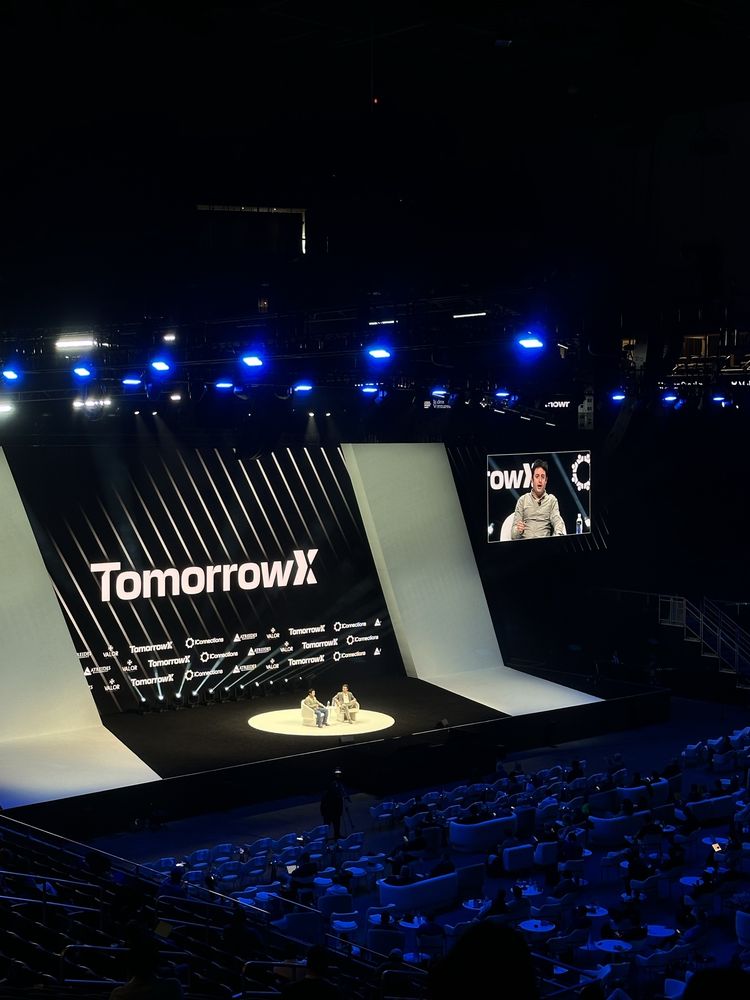 Almost everyone on stage had money riding on what they were talking about, and the format made that hard to miss. Interviewers often came from firms that back the company on stage, like a16z with Coinbase and Valor with Zipline, and the top pass, at $10,000, came with private meetings with the companies. Some speakers just said it out loud! Blackstone's president argued that market negativity has gone too far, then noted that a shakeout would mean less competition for Blackstone. One credit investor said their fund is positioned against the riskier borrowers. Dell's founder, with an earnings report days away, said the build-out only goes wrong if AI simply doesn't work.
On day two, the hosts talked about making a YouTube ad to flip the narrative on data centers, which one of them called a terrible name. As a marketer, I found that last one fascinating! A lot of this summit was about managing how people feel about AI.
Boom vs. bubble
Blackstone's president made the strongest case against a bubble, using three tests. On valuation, the Nasdaq traded at more than 60 times earnings in the dot-com era, compared with about 17 times next year's earnings today, by the speaker's estimate1. On speculation, telecom companies in the 1990s laid fiber and hoped demand would come, while today demand is ahead of supply. On leverage, homebuyers in 2006 borrowed 90% or more. This build-out is mostly paid for by the biggest tech companies, which are expected to generate about $1 trillion of EBITDA (a rough measure of operating cash flow) next year2.
Almost every speaker also reached for a history lesson. Arm's CEO compared AI to the transcontinental railroads, overbuilt in the 1870s until European investors pulled their money and the stock market crashed. The railroads still changed everything. A credit investor who had lived through the telecom and shale booms said it's crazy to think AI won't have periods of oversupply too. Intel's CEO called some correction healthy. My takeaway is that AI could change the world, like the railroads did, and still wipe out the people who paid for it too early.
That same credit investor said 99 out of 100 people they'd talked to that week expected the chip shortage to last another year, which felt skewed too far one way. In their view, the stock and bond markets were already pricing in a bigger risk of too much capacity. Several sessions opened by asking executives about their falling stock prices. Not the easiest opening question!
Contracts first vs. returns first
The biggest disagreement I heard was about how to pay for all of this. Blackstone puts most of its money in only once a tenant, typically a company worth trillions, signs a 15- to 20-year lease. CoreWeave said it only buys chips after a customer signs a take-or-pay contract, meaning the customer pays whether or not it uses the capacity, and it asks customers to prepay 20 to 25%. Micron said its 26 multi-year supply agreements came with $32 billion of upfront cash and commitments.
The CEO of Base Power, a battery and power startup, called that approach backwards. Build something that earns strong returns first, around 30% before any borrowing, and lenders will line up to finance it. Contracts also don't make risk disappear. The interviewer at the Micron session, a 27-year semiconductor veteran, said every take-or-pay deal they'd seen in that time was either broken or became an albatross. Then they called "this time is different" a very dangerous thing for an investor to say, and said it anyway. If the end customers never show up, whoever signed the contract takes the loss.
I spent years in client success at two startups, and my job was getting customers to renew. A take-or-pay deal guarantees payments while the contract lasts. So how many of these customers sign again when it ends?
Lenders vs. accountants
Companies spread the cost of a chip over its useful life, which is called depreciation. CoreWeave said the industry uses about six years3 and argued chips last even longer. Its older A100 chips are now contracted through 2029, roughly eight years of use by CoreWeave's own estimate, at higher prices than their original contracts.
The lenders on the credit panel described something different. They said loans against chips are being paid back in two to three years4, and that a gigawatt of next year's chips may produce 10 times the output of a gigawatt of older ones. If new chips are that much better, how long will the old ones really earn their keep? Depreciation sounds boring, I know! But stretching a chip's useful life makes today's profits look bigger. An investor on the CoreWeave panel said its unsecured debt was trading around a 15% yield, well below face value. CoreWeave's answer was that its returns on chips beat that.
Who pays?
Smaller AI companies. According to the credit panel, the biggest players are hoarding chips and cheap capital, and everyone else pays more to borrow.
- Loans backed by Nvidia or Broadcom7.5–8%
- SpaceX, secured by its chips8.5%
- A strong neocloud, secured by its chipsabout 12%
- Smaller AI clouds and labs, plus warrants15%+
One panelist cited an estimate that neoclouds, the newer AI-focused cloud companies, need to earn 30 to 40% more per gigawatt than big tech on the same chips just to cover their cost of capital. Some run what a panelist called a WeWork-like model: borrow long-term, buy chips, and rent them out short-term. That works in a shortage and breaks in a glut. The panel said some of these companies' convertible bonds trade at 50 to 70 cents on the dollar5, and expects a wave of acquisitions.
Everyday consumers. Intel's CEO said AI demand has pushed memory prices up almost six or seven times, which is squeezing phones and low-end PCs. Part of the build-out's cost lands on people buying a phone or a cheap laptop.
Towns. Meta's president said Meta only builds where it's welcome, and that its utility deal in Richland Parish, Louisiana, will cut residents' power costs by more than $2 billion over the project's life6. Because of a local law that sends tax surpluses to teachers, every teacher in the parish got a $50,000 bonus, on a starting salary of $37,000, according to Meta's president7. Cerebras's CEO went further, calling a school's power bill a rounding error on a multibillion-dollar project and saying the first wave of data center builders tried to be sneaky with towns, which backfired. One host said governors should stop complaining and demand a surcharge from the companies. Meta's president acknowledged that data centers became an issue in the midterms. Every benefit I heard came from the companies themselves. As a MIINT Fellow, I'm learning how impact investors do due diligence, and a company's own numbers are only the first step. I'd want to hear from the people paying the electric bills.
Workers. Construction is booming. Blackstone's president expects about 70,000 workers on its data center sites by the end of next year, up from about 10,000 a couple of years ago. Further down the line it's less clear. Zipline's CEO said delivery drivers are paid less every year, possibly below minimum wage, and that one of Zipline's fleet commanders oversees 100 aircraft, which Zipline frames as fewer, better-paid jobs. An interviewer described anxiety among young people trained for entry-level office jobs, and the answers were mostly encouragement. I didn't hear anyone say how many construction jobs last once a building is finished. As a student heading into internship recruiting, I want to know which entry-level roles companies still plan to hire for.
Banks. Morgan Stanley's head of wealth management argued that AI agents will soon move people's idle cash for them, and that will hit banks where they make money.
Quick guess. How much does the average US household give up each year by leaving cash in low-interest bank accounts, by Morgan Stanley's math?
About $3,000! US deposits total about $21 trillion and earn about 1.8% on average, while the risk-free rate is about 4%.
Banks make a lot of money on the gap between what deposits earn (about 1.8%) and what safe Treasury bills pay (about 4%). That gap mostly exists because moving money is a hassle. Squeeze it toward zero and bank profits shrink, which, the speaker said, is why financial stocks have sold off every time a new AI finance tool is announced. Coinbase's CEO described the same money moving into stablecoins: Coinbase earns about half of the interest income on USDC, and stablecoin payments surge on weekends when banks are closed. Morgan Stanley's case was that this ends in fewer, bigger winners rather than a collapse. When stock quotes moved from fractions to pennies in 2001, spreads collapsed and something like 90% of market makers went out of business, by the speaker's count8, but the firms that adapted thrived.
Will cheaper AI shrink the bill?
The whole build-out assumes demand keeps climbing, and a few talks complicated that. DoorDash's cofounder said its AI spending rose 20 times this year, then leveled off once it switched to cheaper open models it fine-tunes itself. The interviewer said companies doing that get frontier-level results at 30 to 40% of the cost, though spending tends to climb again. Coinbase's CEO said a small model trained on Coinbase's own data beat the top models on a narrow task.
On the other side, AlphaSense's CEO argued that high-stakes work like finance needs the most powerful models, and that the open-model story is pushed by startups with negative margins. AlphaSense's token use is up 10 times this year. If good-enough AI gets cheap fast, the companies that borrowed to build capacity for expensive AI could be the ones left holding it.
What I'm watching, and what I'd ask
I left with a list of numbers to watch: how long chips are really depreciated, how much AI capacity turns into paying customers, what the riskiest borrowers pay, and what families near new data centers pay for power. I also left with questions I'd love to ask:
- CoreWeave: what happens to the eight-year math if next year's chips really produce 10 times more?
- Blackstone: if a shakeout helps you, how do you decide when to wait?
- Meta: what are Richland Parish residents actually paying for power today?
- Micron: what would make a customer walk away from a five-year supply deal?
- The credit panel: what's the first sign a shortage is turning into a glut?
Thank you to the TomorrowX team for saving seats for students, and for putting people on stage who didn't all agree!
Fact-checks
Where public sources differ from what was said on stage, or add context. Checked in November 2026.
- Public data puts it a bit higher: the Nasdaq-100 traded at about 21 times forward earnings at the end of October 2026. Siblis Research. ↩
- I couldn't find a published EBITDA estimate. Reuters, using LSEG estimates, projects the five biggest spenders' operating cash flow rising about $340 billion from 2025 to 2027, while their capex rises about $534 billion. Reuters via The Star, Jul 22, 2026. ↩
- Confirmed: the biggest tech companies depreciate GPUs over roughly five to six years. Fortune argues the hardware's real economic life is closer to three. Fortune, Apr 15, 2026. ↩
- Public deals I found run longer than that and pay down steadily along the way. Lambda's $926 million loan matures at the end of 2030 on a schedule matched to the chips' useful life, its $1 billion loan in 2033, and CoreWeave's $8.5 billion facility in 2032. StorageNewsletter; Lambda, Oct 1, 2026; Barchart. ↩
- Public reports support the top of that range: Nebius's convertible bonds fell to about 70 cents. I couldn't find any reported near 50. Finimize. ↩
- Entergy says the Meta agreement saves customers about $2 billion over 20 years, on top of $650 million announced earlier. These are the companies' own projections. Entergy, Mar 27, 2026. ↩
- Close, but not every teacher gets the same amount. The bonuses come from a 1% local sales tax under a 1968 ordinance, which surged with Meta's construction, and run up to about $50,900 depending on role and years of service. Starting pay for a new teacher with a bachelor's degree is $36,371. Entrepreneur, Jun 15, 2026; Richland Parish salary schedule. ↩
- Directionally right, but 90% is high. The GAO found NYSE specialist firms fell from 25 to 7 between 1999 and 2004, and Nasdaq market makers from almost 500 to about 260, with other causes like electronic trading also at play. GAO, May 2005. ↩